
Anthony Bedford
The Business Analyst Playbook
A practical guide to the core skills, techniques, and deliverables every business analyst needs to gather requirements, manage stakeholders, and drive better business decisions.
3 modules · 9 lessons
This export only includes free-preview lessons. Enroll in the course to unlock the full export.
Module 1
Foundations of Business Analysis
What a Business Analyst Actually Does
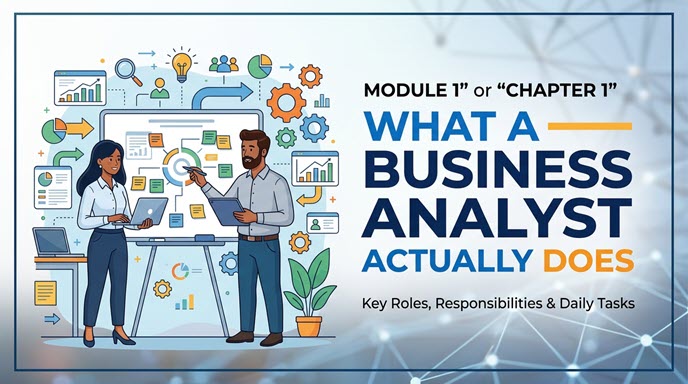
Every organization runs into the same problem eventually: the people who understand the business and the people who build the systems speak different languages. A Business Analyst (BA) exists to close that gap. Rather than owning a single deliverable like a piece of code or a marketing campaign, a BA's job is to make sure the right problem gets solved, with a solution the business can actually use.
The Translator Role
Think of a BA as a translator who works in both directions. On one side, a sales director might say "our reps waste too much time on manual reporting." On the other side, a development team needs something far more specific: which reports, generated how often, pulling data from which systems, and delivered in what format. The BA sits in the middle, turning a vague business complaint into a requirement precise enough to build against, and then turning technical constraints back into language the business side can weigh in on.
Why This Role Exists
Without a BA, two failure modes tend to show up. First, teams build the wrong thing entirely, because nobody asked enough questions before development started. Second, teams build the right thing badly, because requirements were assumed rather than confirmed, and small misunderstandings compound into a solution nobody wanted. A skilled BA prevents both by treating every assumption as something to be tested, not accepted.
What a Typical Week Looks Like
In practice, a BA's calendar is a mix of activities: interviewing stakeholders to understand a problem, running workshops to resolve disagreements about scope, writing and refining requirements documents, and reviewing built functionality to confirm it matches what was asked for. None of these activities produce a finished product on their own — the BA's output is clarity, which everyone else depends on to do their job well.
Key Takeaways
A BA's core job is turning ambiguous business needs into requirements precise enough to build against.
The role exists to prevent two failure modes: building the wrong thing, and building the right thing badly.
Most of a BA's week is spent facilitating conversations and documenting decisions, not producing a finished deliverable themselves.
Treat every assumption as something to verify, not something to accept at face value.
The Business Analysis Lifecycle
Enroll in the course to unlock this lesson.
Core Competencies and Mindset
Enroll in the course to unlock this lesson.
Module 2
Requirements & Stakeholder Management
Identifying and Mapping Stakeholders
Enroll in the course to unlock this lesson.
Elicitation Techniques That Work
Enroll in the course to unlock this lesson.
Writing Clear Requirements Documents
Enroll in the course to unlock this lesson.
Module 3
Analysis Techniques & Delivery
Process Mapping and Gap Analysis
Enroll in the course to unlock this lesson.
Prioritization and Trade-off Decisions
Enroll in the course to unlock this lesson.
Handing Off to Delivery Teams
Enroll in the course to unlock this lesson.